Golf Travel
  Leaderboards
  Become a Member
  Shop
Shop  Trade In
 Course Spotlight
Inside Pebble Beach Golf Links: History, Design and What Makes It Special
By Brendon Elliott, PGA
Published on
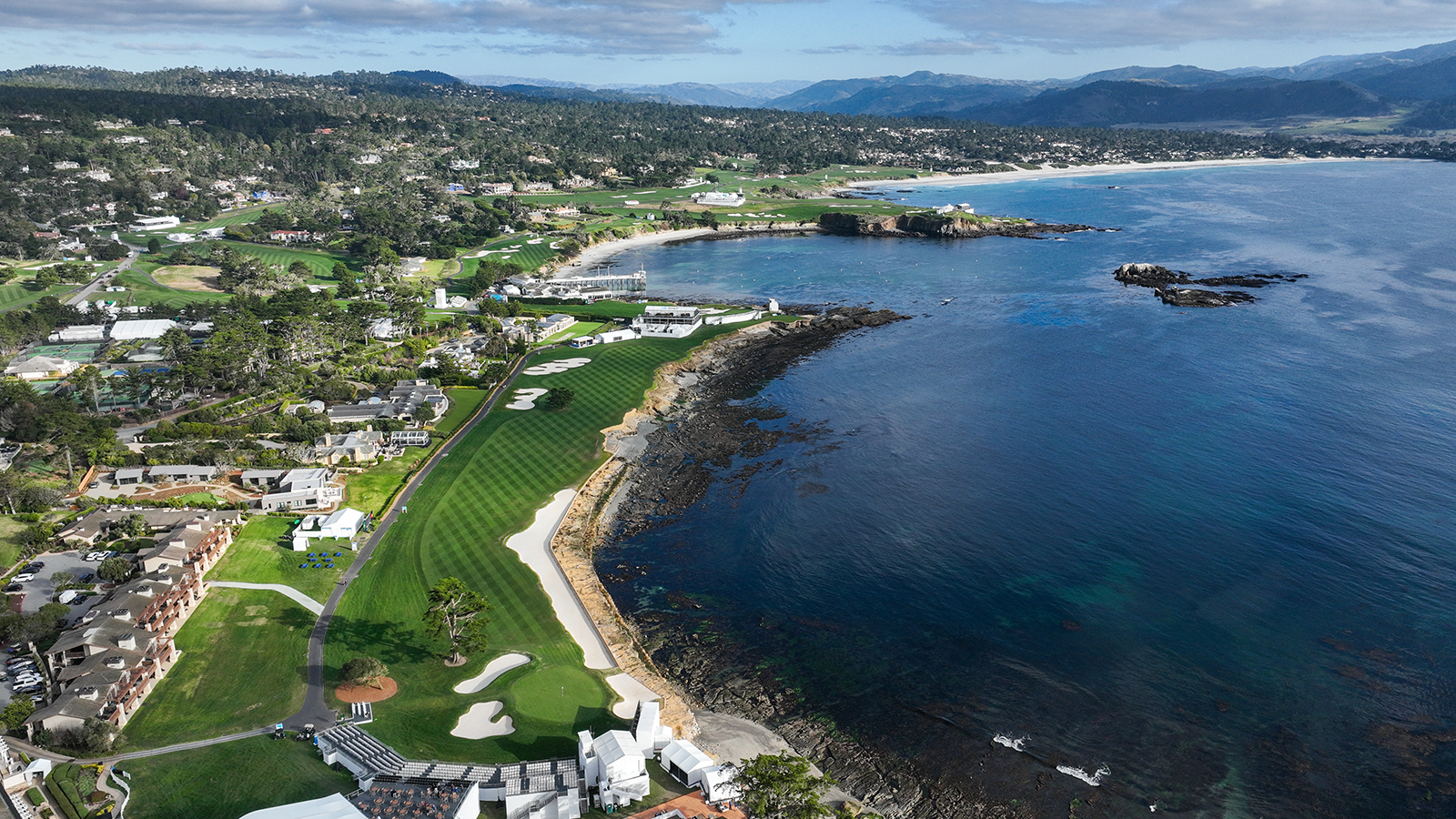
There’s a golf course on California’s Monterey Peninsula where the Pacific Ocean crashes against rocky cliffs, where Jack Nicklaus hit a 1-iron that struck the flagstick, where Tom Watson chipped in from the rough and told his caddie, “I told you so,” and where Tiger Woods won by 15 shots in a U.S. Open.
This week, the PGA Tour returns to Pebble Beach Golf Links for the AT&T Pebble Beach Pro-Am, and the world’s best players will test themselves on what Golf Digest has called America’s number one public golf course since 2003.
A Course Built by Champions
Jack Neville and Douglas Grant designed Pebble Beach Golf Links in 1919 with one objective: place as many holes as possible along the rugged Monterey coastline. They succeeded spectacularly, creating a figure-eight layout that delivers some of golf’s most breathtaking and challenging holes.
The course stretches to 6,989 yards for this week’s tournament, playing as a par 72. That makes it the second-shortest course the tour played last year, behind only TPC River Highlands at 6,844 yards. But don’t let the yardage fool you. This is championship golf at its finest.
Pete Bachman, in his seventh year as superintendent at Pebble Beach, maintains the course to exacting standards year-round. This marks his fifth professional event as superintendent, including his third Pebble Beach Pro-Am. In his 14 years with the Pebble Beach Company, he’s been part of one U.S. Open, nine Pro-Ams, eight Pure Insurance Championships and eight Pebble Beach Invitationals.
Bachman was named the 2024 superintendent of the year by the Golf Course Superintendents Association of Northern California. His crew of 29 agronomy employees, plus 20 tournament volunteers, keeps Pebble Beach in pristine condition despite hosting 78,000 rounds annually.
The Agronomic Challenge
Pebble Beach presents unique maintenance challenges. The greens are pure Poa annua, cut to .125 inches and averaging just 3,500 square feet. Those are the smallest greens on tour last year, giving players minimal margin for error. Only Harbour Town’s greens were close at 3,700 square feet.
The course also features 116 bunkers, the third-most on tour last year behind only Oakmont’s 168 and Philadelphia Cricket Club’s 118. The Pacific Ocean, Stillwater Cove, and Carmel Bay directly impact play on nine holes, primarily along the dramatic cliffs on holes 4 through 10, plus the finishing 17th and 18th. The most critical water-involved holes are the par-3 7th perched on the cliff edge, the par-4 8th, where the second shot plays over the beach, and the iconic closing stretch at 17 and 18, where the ocean defines every shot.
Fairways and rough are a mix of ryegrass and Poa annua, maintained over sandy loam soil with fair drainage. The course sits at elevations ranging from sea level at the 18th hole to 100 feet at the 15th tee.
Since last year’s tournament, Bachman’s crew renovated the 10th green and moved the championship tee on the sixth hole. The course plays 17 yards longer than in 2025.
Spyglass Hill Joins the Rotation
The Pebble Beach Pro-Am is unique in that it rotates between Pebble Beach and Spyglass Hill for the first three rounds before finishing Sunday at Pebble Beach. Spyglass Hill, designed by Robert Trent Jones Sr. in 1966, plays to 7,071 yards this week, up 30 yards from last year.
Sean Sherbert is in his second year as superintendent at Spyglass Hill after six years with the course, including time as an assistant. He previously worked at Pebble Beach as senior assistant and at Poppy Hills as an assistant.
Sherbert’s crew of 24 agronomy employees and 35 tournament volunteers maintain Spyglass Hill’s Poa annua greens at .120 inches, averaging 5,000 square feet. The course features 62 bunkers covering 3.29 acres, with water in play on four holes.
Last spring, Sherbert oversaw a major renovation of the 15th green complex, increasing the green by roughly 1,000 square feet and nearly doubling the pinnable area. The new design brings the back bunkers and pond more into play. His crew also planted 50 trees, mainly oaks with a couple of cypress, outside of and between holes.
A Stage for History
Pebble Beach has hosted six U.S. Opens and one PGA Championship, with another U.S. Open scheduled for 2027. The course will host the U.S. Open again in 2032, 2037 and 2044, plus the U.S. Women’s Open in 2035, 2040 and 2048.
The 1972 U.S. Open saw Nicklaus secure his 12th major with that famous 1-iron on the 17th hole. In 1982, Watson chipped in from the rough on 17, then birdied 18 to beat Nicklaus by two shots. Tom Kite won in 1992 in brutal conditions, with only two players finishing under par.
But perhaps no performance at Pebble Beach matches Tiger Woods' in 2000. He shot 65-69-71-67 to finish at 272, 12 under par, winning by 15 shots. It remains the largest margin of victory in major championship history.
What Makes It Special
Pebble Beach proves that great golf doesn’t require 7,500 yards. At under 7,000 yards with the smallest greens on tour, it demands precision over power. The course rewards strategic thinking and punishes mistakes.
This week, the circus comes to town again. Bachman and Sherbert will have their courses in perfect condition. The pros will navigate the cliffs and bunkers and tiny greens. And somewhere along the way, someone will hit a shot that becomes part of Pebble Beach lore.
That’s championship golf on the Monterey Peninsula.
PGA of America Golf Professional Brendon Elliott is an award-winning coach and golf writer. Read his recent “The Starter” on R.org and his stories on Athlon Sports. To stay updated on his latest work, sign up for his newsletter and visit OneMoreRollGolf.com.